Key points
- First aid is the act of helping someone after a sudden injury or medical episode.
- In an emergency, good first aid can save a person's life.
- The acronym ‘DRSABCD’ is a good way to remember the basic first aid steps.
- Some medical conditions need specific care; if your child has an ongoing condition like anaphylaxis, it is important to know how to help them in an emergency.
- A good first aid kit will help you manage a medical incident.
- Call an ambulance (000) immediately if someone is having a medical emergency. You can also dial 112 on a mobile phone.
What is first aid?
First aid is the help you give to someone straight after they have a sudden injury or medical episode. It is best to give first aid until the person gets better or you pass their care to paramedics.
The main goals of first aid are to:
- preserve life
- stop an illness or injury from getting worse
- relieve pain, if possible
- help recovery
- support the person until paramedics arrive.
The type of first aid care needed depends on a person’s condition. It may be as simple as getting water for someone who feels faint or as serious as giving cardiopulmonary resuscitation (CPR) to someone having a heart attack. First aid can be the difference
between life and death in these cases.
What is DRSABCD?
DRSABCD is an acronym that helps you remember the basic first-aid steps. It stands for ‘Danger, Response, Send (for help), Airway, Breathing, CPR, Defibrillation,’ – seven actions to take when looking after someone during a medical incident. If it is
a minor incident, you may only need to follow a few steps. The DRSABCD steps are designed to help everyone, from babies to older adults.
- D stands for danger = Check your surroundings to ensure there are no dangers to you or the person who needs help. For example, remove any pets from the area.
- R stands for response = See if the person is conscious and responsive; do they reply if you speak to them or respond if you touch their shoulder? If it is a baby, try pinching their earlobe to see if they respond.
- S stands for send for help = Call an ambulance (000) or ask someone nearby to call. You should stay on the phone until help arrives. It is best to put your phone on speaker when you dial, so you can use your hands to give first aid.
- A stands for airway = Check if anything is blocking the person's mouth or throat, and whether they are breathing.
- If they are conscious and their airway is clear, ask how you can help them.
- If they are conscious but there is something blocking their airway, it is best for them to stay in the same position and try to clear the blockage. For example, it may help them to sit up and cough.
- If they are unconscious and there is nothing blocking their airway, gently tilt their head back into a neutral position and lift their chin. Try to keep their head tilted back into a neutral position so their airway is as open as possible.
- If they are unconscious and there is something blocking their airway, roll them onto their side and try to clear the blockage. If you clear the blockage, roll them onto their back, then gently tilt their head back and lift their chin
to check their breathing. Try to keep their head tilted back into a neutral position so their airway is as open as possible.
- B stands for breathing = See if the person is breathing. You should watch, listen and feel for 10 seconds. If they are breathing, place them in the recovery position (details below) and keep watching them. If they are not breathing and unresponsive,
start CPR immediately.
- C stands for CPR = To perform CPR, give 30 chest compressions followed by two breaths. Watch the videos below for a demonstration. If you do not want to give breaths, continue with chest compressions.
Only stop CPR:
- to swap with another person
- to use a defibrillator
- when paramedics take over
- if the person starts breathing
- if you are physically unable to continue.
- D stands for defibrillator = If the person is not breathing and is unconscious, start using an automated external defibrillator (AED) if available. The machine gives an electric shock to get the heart beating normally again. Defibrillators
are very easy to use; most will give verbal instructions, so you just need to follow what they tell you to do.
Recovery position
The recovery position is a way to keep someone’s airway clear and open after a medical incident, excluding injuries to their spine. It also helps to stop someone from choking on any fluid or vomit.
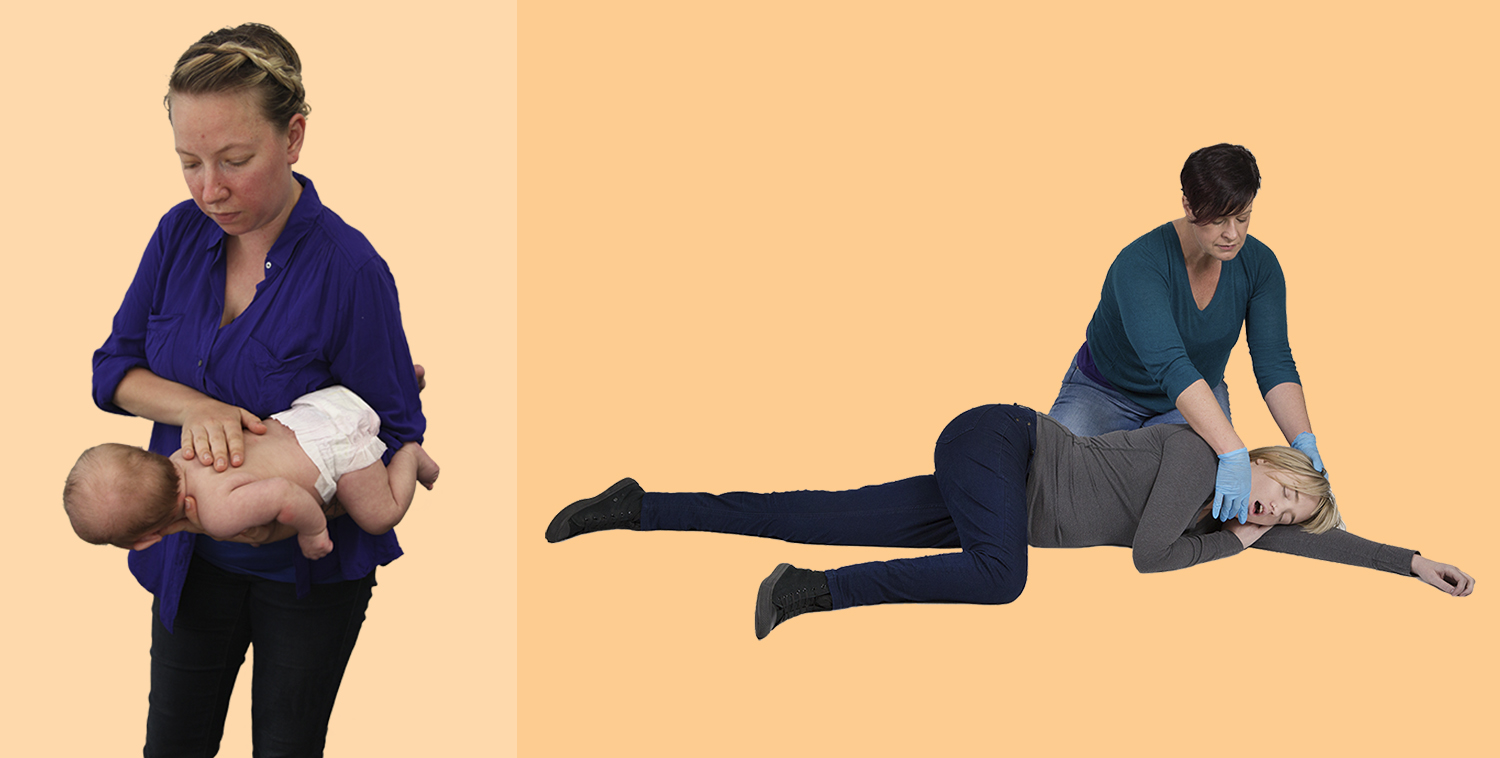
Figure one: Two demonstrations of recovery positions – left for babies under one year, right for adults. Images have been reproduced with permission from St John Ambulance.
Babies under one year
There are two safe ways to put a baby into the recovery position
- Lie the baby face down on your forearm and support their head with your hand.
- Place the baby on their side, with their head angled so their mouth faces down. Try to keep them stable in this position; you can put a small pillow or rolled-up blanket behind their back, so they do not roll backwards.
Children over one year and adults
- Kneel beside the person and make sure they are lying on their back. Then, fold the arm closest to you across their chest. Place the other arm directly out from their body.
- Bend their leg closest to you so their foot is flat on the ground.
- Gently support their neck and roll their body towards their outstretched arm so their bent knee rests on the ground and they are on their side. This position will stop them from rolling onto their face.
Do not put someone in the recovery position if you think they could have a spinal injury. Someone may have a spinal injury if they:
- fell from a height
- were in a car or bicycle crash or hit by a car
- were hit directly in the back, neck or head
- complain of severe pain in their neck or back
- are unable to move their neck
- feel weak, numb or unable to move
- have lost control of their limbs, bladder or bowels.
First aid for other emergencies
Some medical emergencies need special treatment. Examples include:
If your child has an ongoing health condition like asthma or severe allergies, it is crucial to know how to care for them in an emergency. If your child is having an asthma attack or anaphylactic
reaction, call an ambulance (000) immediately.
Steps for giving CPR to children
CPR for babies under one year
This video shows how to give CPR to a baby under one year.
CPR for children (over one year) and teens
This video shows how to give CPR to children over one year and teens.
What to include in a first aid kit
An organised and well-stocked first aid kit will help you manage a medical incident. You can buy a pre-made first aid kit with essential items at a pharmacy or make one yourself.
The most important items to put in a first aid kit are:
- Sticky bandages or plasters
- Non-stick wound dressings
- Triangle bandages
- Crepe bandages
- Skin tape
- Gauze
- Eye pads
- Antiseptic wipes
- Tweezers
- Saline solution
- Safety pins
- Disposable gloves
- Any medicine your child needs, such as an adrenaline autoinjector.
If you have space in your kit, you may also like to pack items such as an instant cold pack, anti-itch ointment, antiseptic and medicines like paracetamol. If you put any medicines in your first-aid kit, ensure the kit is locked or out of reach of children.
First aid kit tips
- Keep your first aid kit fully stocked; always replace items if you use them.
- Check the expiry date of items in your kit. Some things will last, but creams and medicines will expire or get less effective over time.
- Ensure all packages are sealed. For example, do not use an adhesive bandage if the package is already open.
- Clean all multiple-use items thoroughly before putting them back into the kit.
Common questions about first aid
Should I follow baby or child CPR instructions for my toddler?
The only difference between baby, child and adult CPR is how you perform it – using fingers, one hand or two hands. The age is a guide only. If your child's chest is large enough for you to use both hands for chest compressions, you should do
so. Toddlers need 30 chest compressions, followed by two breaths, during CPR – regardless of their size.
Do I need to take a child first aid course?
Although most parents and caregivers will never need to give CPR to their own children, it is good to be prepared for emergencies. Child first aid courses teach how to perform first aid on children. They tend to focus on medical emergencies that
are more likely to happen to young people and how to treat them.
It is particularly important to know first aid if your child has an ongoing health condition that puts them at higher risk of needing CPR.
How often do I need to do first aid training?
If you have taken a first aid course, it is best practice to refresh your CPR training every year and your first aid certification every three years. This ensures your skills are up-to-date and you will know what to do in an emergency without
hesitation. First aid certifications do not legally 'expire' in Australia, but if you are a registered first aider at your workplace, your employer may require you to get re-certified.
When can I stop giving CPR?
There are five main reasons to stop giving CPR: to rotate with another person, use a defibrillator, pass care over to paramedics, if the person starts breathing, or if you are physically unable to continue. You may also want to stop giving CPR
if you feel unsafe.
For more information
Developed by The Royal Children’s Hospital Trauma department. We acknowledge the input of RCH consumers and carers.
Reviewed December 2025
Please always seek the most recent advice from a registered and practising clinician.