Key points
- Babies cry to communicate their needs. They may be hungry, tired, distressed, uncomfortable, or need social connection.
- All babies are different – some cry for longer and are more unsettled than others.
- Excessive crying refers to babies who cry more than expected or have long periods of time where they cannot settle. This can be distressing and tiring for carers.
- Being unsettled and crying a lot is very common in young babies up to four months old. In most cases, these behaviours tend to get better as the baby gets older.
- Most of the time, there is no medical reason for a baby’s crying.
- You may need to try different strategies to comfort your baby. Babies often feel safer and more secure when they are with you.
- It can be very stressful and tiring when your baby is crying and unsettled. You can speak with your Maternal and Child Health Nurse or your child’s doctor for strategies and support.
Why do babies cry?
Babies cry to let their carers know they need them. All babies are different – some are naturally more unsettled than others.
It is very common for young babies to have periods of time where they cry a lot and cannot settle with regular soothing techniques.
What is excessive crying in a baby?
Excessive crying refers to babies who cry more than expected or have long periods of time where they cannot settle. It is sometimes called ‘colic’; however, this term can be unhelpful as it sounds like there is something wrong inside the baby’s tummy
when this is not usually the case.
Around one in five newborn babies cry excessively or can be hard to settle; it affects families of all cultures around the world.
Caring for an unsettled baby who cries excessively can be very demanding, tiring, and distressing.
What causes excessive crying?
Crying is a normal part of growth and development. Some babies seem to cry more or need a lot of soothing. This does not mean there is anything wrong with them – all babies respond differently to their environment.
Changes and new experiences
All babies have different sensitivity levels to things inside and outside their bodies. This includes physical and emotional events, and new experiences. Sometimes, babies cry because they:
- have a wet nappy
- feel too hot or cold
- have wind (gas in their stomach or bowel)
- are hungry or tired
- feel anxious or unhappy
- need company or want to be close to their carer.
Babies may cry more if they are very aware of sensations in their body or changes in the world around them. For example, some babies are more alert and experience feelings more strongly than others.
Many babies are also very attuned to the emotions of their family; they can find it hard to settle when their carer is stressed.
Medical reason
In most cases, there is no medical reason for a baby’s crying. Babies are simply communicating with their caregiver.
If you are worried about your baby’s crying, it may help to speak with your Maternal and Child Health Nurse or your child’s doctor. They can examine your baby and talk with you about any possible medical causes.
Signs and symptoms of excessive crying
PURPLE crying
Health professionals often use the acronym PURPLE to describe the common signs and symptoms they see in unsettled babies who cry excessively.
- P = Peak of crying. Your baby’s crying may increase for the first six to eight weeks of their life and decrease after four months.
- U = Unexpected. Your baby’s crying may come and go without a clear reason why.
- R = Resists soothing. Your baby may not stop crying, despite attempts to soothe them.
- P = Pain-like face. Your baby may look like they are in pain while crying.
- L = Long lasting. Your baby may cry for five hours a day or even longer.
- E = Evening. Your baby may cry more in the late afternoon and early evening.
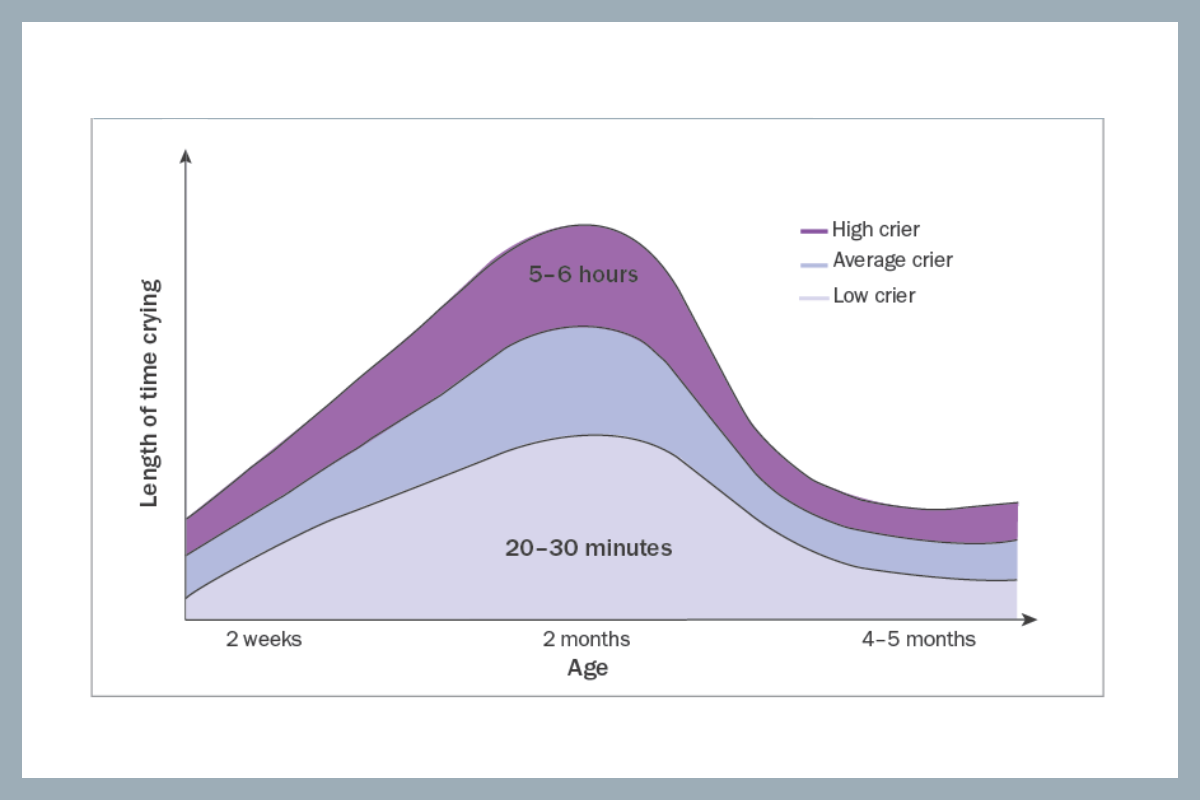
Figure one: PURPLE crying graphic. Shared with permission from ©Medicine Today 2026.
If your baby is unsettled and cries excessively, their cries will often be loud, and they may look red in the face. Some babies will also pull up their legs and arch their back.
How to care for an unsettled baby at home
The following strategies may help if you are having trouble soothing your baby:
- Check if there are any clear reasons your baby may be unsettled.
- For example:
- Could they be hungry?
- Do they need a nappy change?
- Is something making them uncomfortable?
- Are they unwell?
- Consider what may help your baby feel most secure and cared for
- If your baby is well and you have met their physical needs, they may be communicating that they need to be close to you. You could:
- Swaddle them
- Keep them close to you, such as in a baby carrier
- Talk softly to them and let them know you are there to keep them safe
- Rock them gently
- Take them somewhere calm and quiet
- Go for a walk with them in a pram
- Give them a warm bath
- Try a baby massage
- Let them suck for comfort, such as through breast contact or a dummy.
- Arrange extra support
- Ask a family member or friend to support you, if you can.
- Try to reduce other demands when your baby is unsettled so you can focus on being with them. For example, if your baby is unsettled around family dinner time, you could eat a pre-made meal rather than cooking.
- Consider whether you could get support with chores or use other time-saving measures, such as online grocery shopping.
- Get help for yourself
- You need to take care of yourself so that you can look after your baby – especially when they are unsettled.
- When you are tired and stressed, your baby may sense this. It can make them feel less secure and act more unsettled.
- Many parents experience postnatal depression. If you think you may be affected, speak with your doctor or Maternal and Child Health Nurse for support.
- Keep your baby safe
- If you are feeling frustrated or angry, it is okay to leave your baby in a safe place so you can take a few moments to clear your head, take a breath, and calm down.
- If you are worried you might hurt your baby, you should place them somewhere safe, like their cot, and seek immediate support from another adult. You could also call PANDA (Perinatal Anxiety and Depression Australia) on 1300 726 306 or Lifeline on 13 11 14.
- Never shake your baby. Shaking babies can cause brain damage and lifelong disability.
- It is important to let others know if you feel you may not be coping. You do not have to manage alone.
Getting support
For your baby
If you are concerned about your baby’s crying and health, you should talk to a health professional, such as your Maternal and Child Health Nurse or your child’s doctor. They may refer you to a paediatrician. In Victoria, there are also Early
Parenting Centres that provide specialist support for families with children up to four years old.
For yourself
Caring for an unsettled baby is incredibly hard. It is important to get the help you need. This may be through family, friends, or your local parents’ group. You can also talk to your doctor; they may refer you to a psychologist or help you explore other
options.
For mental health support, you could also contact:
- Beyond Blue – Mental health support and information.
- PANDA (Perinatal Anxiety and Depression Australia – mental health support during pregnancy and the first year of parenthood.
- Lifeline – Mental health crisis support.
- Visit the Lifeline website, use their online chat, call 13 11 14, or text 0477 13 11 14.
- The Orange Door – Help for people experiencing family violence, and for those who need support with caring for children and young people.
- 13YARN – Mental health support for Aboriginal or Torres Strait Islander people.
When to get help
Call an ambulance (000) if:
|
- your child is very unwell and needs urgent medical attention. For example, poor feeding leading to severe dehydration.
- you are worried you may harm yourself or your baby and are unable to keep yourself or your baby safe.
|
|
Go to a hospital if:
|
- you are unable to settle your baby and are concerned they are unwell.
|
|
See a doctor or health professional if:
|
- you are worried that your baby has a medical cause for crying.
- you feel like you may not be coping.
- you feel that your child’s crying is impacting your relationship with them, or you are finding it hard to feel positive about them.
- your mental health or your relationship with your partner is being affected.
|
|
Look after your child at home if:
|
- you are finding ways to settle your baby, and you are coping well with caring for them – even if they are unsettled at times.
|
Common questions about crying and unsettled babies
Is it my fault that my baby will not stop crying?
It is common to worry that your baby’s crying is caused by something you have done. However, if you are keeping your baby safe, tending to their needs, and they are otherwise healthy and well, their crying is likely just their way of communicating
with you.
Parents who have experienced mental health troubles, family stress, or difficult times in their own childhood may feel less confidence when caring for their own baby. This can make it hard for people to be responsive or playful with their baby.
If your baby is hard to soothe, and you are worried about how you are looking after them, it is best to speak with someone about it. This could be a family member, friend, or health professional.
When are babies usually the most unsettled?
Babies can start crying and fussing at any time, but they tend to cry more in their first six to eight weeks, and start to settle after four months. Excessive crying often occurs in the late afternoon and early evening.
Is there a cure for excessive crying (colic)?
Many products claim to reduce colic and excessive crying in babies, such as medicines, sleep devices, and feeding programs. However, there is often no evidence that these products are helpful, and some can even be harmful. It is best to speak
with a trusted health care professional – such as your Maternal and Child Health Nurse or family doctor – for advice about alternative treatments before trying them with your baby.
Do probiotics help to reduce crying in babies?
For some exclusively breastfed babies, the probiotic Lactobacillus
reuteri DSM17938 may help with excessive crying, but it will not take away the crying entirely. Scientific studies suggest that probiotics do not make any difference to excessive crying in formula-fed babies.
Does my baby need medicine if they will not stop crying?
Medicine is not usually recommended for excessive crying. It may mask illnesses, interfere with feeding, or make your baby too sleepy. Only give your baby medicine on the advice of their doctor or nurse.
My baby looks like they are in pain when they cry, but the doctor said there is nothing medically wrong. Should I get a second opinion?
Excessive crying in babies between two weeks and four months old can look as though they are in pain, but most of the time, there is no medical cause. You know your baby best. if you are worried, it can help to get a second opinion from another
health care professional.
This podcast is also available in audio format below, and on Apple Podcasts and
Spotify.
For more information
Developed by The Royal Children’s Hospital Centre for Community Child Health department, with input from the General Medicine department. We acknowledge the input of RCH consumers and carers.
Reviewed September 2026
Please always seek the most recent advice from a registered and practising clinician.