Please note all people seeking asylum are entitled to free medical care in Victorian hospitals - see Hospital access for people seeking asylum (Dec 2020). This access has been in place in Victoria from 2005. Also see SRSS page.
Background
An asylum seeker is someone who has applied for refugee status and who is awaiting a decision on this application. See:
Refugee policy and timeline. Asylum seekers in Australia can broadly be divided by:
Whether they have a valid visa on arrival - This determines whether they are (or have been) subject to mandatory immigration detention and whether they are eligible for permanent protection.
- Boat arrivals without a valid visa - subject to mandatory detention, eligible for temporary protection (not permanent protection). From 2022, there have been few boat arrivals, they have been sent to Nauru for offshore processing and settlement - see Refugee Council of Australia (RCOA).
- Plane arrivals without a valid visa or plane arrivals who do not clear immigration - subject to mandatory detention, eligible for temporary protection (not permanent protection).
- Plane arrivals who clear immigration (on a valid visa i.e. student, tourist, work, other) - not subject to mandatory detention, eligible for permanent protection.
Their date of arrival - This determines how their protection claims are processed and whether they are/were subject to offshore processing/resettlement
- People who arrived by boat without a visa after 13 Aug 2012 (and before 19 July 2013) could be subject to offshore processing and offshore settlement.
- People who arrived by boat without a visa after 19 Jul 2013 were subject to offshore processing and offshore settlement. Many of this group remained in detention on Christmas Island or mainland Australia, and were then included in the 'legacy caseload' at the end of 2014 (and remained in Australia).
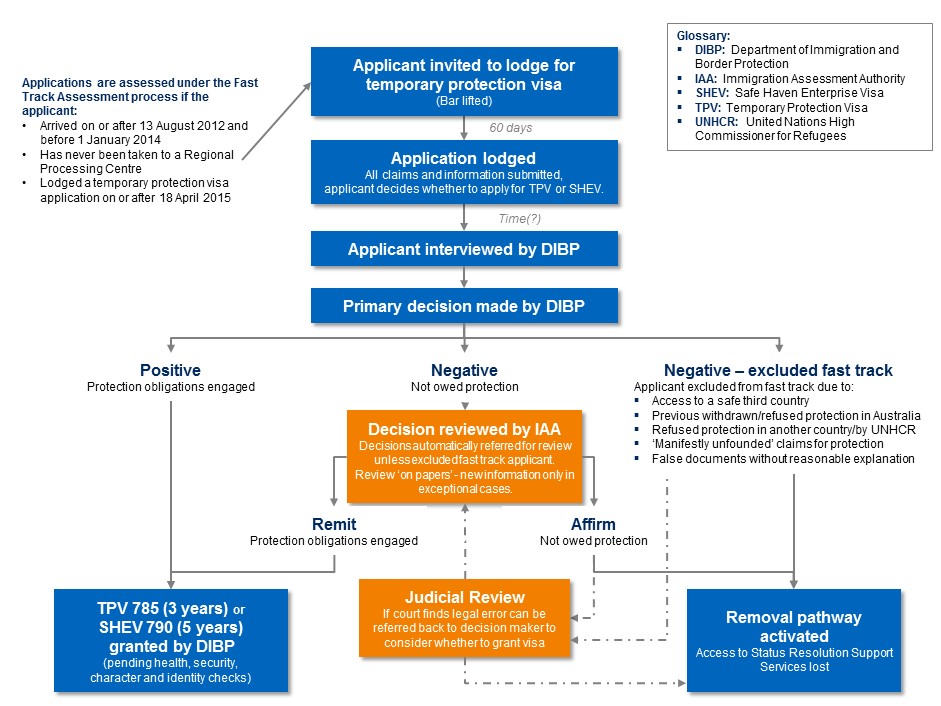
- People who arrived by boat without a visa between 13 Aug 2012 and 1 Jan 2014 had their protection claims processed under the 'Fast Track Assessment' process (see figure below for historical reference).
Their stage in the protection claim process - There were substantial delays in processing protection claims for people who arrived after Aug 2012 - processing halted between Sep 2013 and May 2015 and some individuals are still (2026) awaiting primary decisions. The stages in the protection claim process can be divided into:
- Assessment by the Department of Home Affairs (DHA).
- Review of negative DHA decision.
- Judicial review of refusal by appeal body.
- Review within the judicial system.
People who have had their claims assessed and declined at all stages of review may be described as 'finally determined'.
Groups of asylum seekers include:
Asylum seekers in held immigration detention
The number of asylum seekers in held detention peaked in 2011-2016. As of Jun 2026, the detention population is 1121 people, 88.4% have a criminal history (section 501 cancellations) and approximately 11.4% are people who arrived by boat without a valid visa ('unauthorised maritime arrivals' - UMA). The last asylum seeker children who spent time in Nauru and were held in prolonged detention were released in April 2016. A small number of children remain in prolonged held detention (2026). Detention centres also have ongoing turnover - with flows in and out of the detention network.
Asylum seekers in community detention (residence determination)
As of Jun 2026, there are 86 people in community detention (CD), some are people transferred back from offshore detention for medical reasons, now many years ago.
Asylum seekers in the community
- People on a
Bridging visa E (BVE) who are awaiting a decision on their protection claim. Previously (2012-2018) this was predominantly people who arrived by boat without a valid visa (UMA) and had spent time in held detention. As of Mar 2026, there are still 4656 UMA, 1930 are in Victoria. Of the total, 3738 have a current BVE.
- People on a Final Departure Bridging Visa E (FDBVE) - some people in CD were transitioned onto a FDBVE (and moved out of community detention). The FDBVE was announced in Aug 2017 and initially applied to adults who arrived alone (in late 2017), and was then extended to a small number of families with children (from mid-2018).
- People who arrived with a valid visa (i.e. usually by plane) and have claimed asylum (people in this group may: i) remain on their entry (substantive) visa, ii) be on bridging visas that revert to the conditions of their substantive visa, iii) be on a BVE. Individuals in this group should have a letter acknowledging they have submitted a protection claim.
- People who have had an initial (or later) claim rejected and are in a review process, or awaiting judicial review/outcomes. Individuals who have lodged for judicial review may also have a BVE or a letter noting they have reapplied for a BVE. Often this cohort have short duration BVE.
- A small number of asylum seekers who arrived by boat (around 70 people) did not apply for protection prior to the 1 Oct 2017 deadline, and became subject to removal from Australia. This group were also placed on a 6-month FDBVE, with work rights and Medicare access. Subsequent pathways for this cohort are not clear.
Asylum seeker identification
There are several means of identifying
asylum seeker status; also see information on the DHA
Immicards. From 2019,
Public Transport Victoria (PTV) cards have also recognised asylum status.
Asylum seekers found to be owed Australia's protection (refugees)
Prior to 13 Aug 2012 (all asylum seekers; ongoing for asylum seekers who arrive by plane)
People who were successful in their asylum claim were granted a permanent Protection visa (subclass 866). This visa grants permanent residency, work rights, Centrelink eligibility, Medicare and settlement support; therefore 866 visa holders are no longer asylum seekers. People who arrived by boat before 13 Aug 2012 and whose claims were not finalised, were then subject to retrospective application of Temporary Protection Visas (TPV) - either a TPV (subclass 785) or Safe Haven Enterprise Visas (SHEV, subclass 790). This cohort have now mostly transitioned across to a Resolution of Status Visa (RoS, subclass 851). Asylum seekers who arrive by plane and who are found to be refugees are granted a Protection visa (subclass 866).
People on Temporary Protection Visas
TPVs were proposed for reintroduction in Oct 2013 - see NSW
Refugee Advice and Casework Service (RACS) Factsheet from that time.
Legislation changes in Dec 2014 allowed TPVs to proceed, reintroducing the
TPV 785 (XD) (available from May 2015) and introducing a new form of
SHEV Visa (790) (available from Jul 2015). SHEV arrangements included Victoria from Oct 2016. Most temporary protection visa holders (TPV or SHEV) have now transitioned across to a RoS Visa (subclass 851).
Numbers
In 2026, there are:
- Immigration detention statistics Jun 2026:
- 1121 people, including 128 UMA in held detention (219 people, including 29 UMA in Melbourne Immigration Detention Centre). The average duration of detention is 456 days, and 18% of the detention population have been detained 2 years or longer (21.9% detained 3 years or longer).
- 74 people in 'alternative places of detention' (APODs) (including 15 people in APODs in Melbourne).
- 86 asylum seekers in community detention (43, including 23 children in Victoria) - 66% for longer than 5 years.
- UMA legacy caseload statistics May 2026:
- 32,217 UMA arrivals (10,929 in Victoria): 25,829 RoS Visa subclass 851, 162 TPV subclass 785, 921 SHEV visa subclass 790, 564 awaiting primary decision, 935 refused/cancelled/expired, and 3806 otherwise resolved.
- UMA on a BVE statistics Mar 2026:
- 4656 people (3738 with a current BVE), including approx. 310 children. In Victoria 1930 people (150 children).
- An unknown number of non-maritime arrival asylum seekers living in the community - noting that nationally there were
23,576 protection visa applications lodged in 2024-25 and 25,210 in 2023-24 (i.e. plane arrivals with a valid visa who lodged a protection claim). UNHCR popstats app estimates there are 83,582 people seeking asylum in Australia in 2025.
Asylum seeker health screening
All asylum seekers should have had a health assessment – either in held detention (previously IHMS, now Healthcare Australia (HCA) - see DHA), or in the community after release from detention as part of refugee healthcare, or by
BUPA (contracted by DHA). This assessment is similar to the offshore Immigration Medical Examination.
- For adults and adolescents 15 years and older this comprises: chest x-ray (CXR), limited blood testing including FBE; HIV, hepatitis B, hepatitis C and syphilis screening. Additional tuberculosis (TB) screening is provided for people in held detention with known TB exposure en-route to Australia or in detention - using interferon-gamma-release assays (IGRA).
- For children <15 years this comprises: CXR for children 11 years and older. Additional health screening was introduced from mid-2014 for children
<15 years in held detention - details were never publicly available, although clinical experience suggested this was similar to adult screening. TB screening for all children aged 2-10 years (Mantoux test or IGRA, generally IGRA) was introduced in Nov 2016, including for asylum seeker children, who were by that time in the community (as they were assessed for a substantive visa).
- Immunisation catch-up: should be provided for people in held detention with all Australian schedule vaccines, including varicella vaccine and HPV; and additional vaccines including hepatitis A and influenza. Available evidence suggests the majority of individuals released from detention still required catch-up vaccinations at the time of release.
Detention health checks were recorded on a Health Discharge Assessment (HDA) - for enquiries on past assessments, email general.enquiries@primaryhsa.com.au.
Health assessments - 2017 BUPA letters (historical information)
In late 2016/early 2017, asylum seekers were sent proforma letters from the (then) DIBP requesting health examinations as part of the legacy caseload processing - to be completed at BUPA Medical Visa Services. Key details included:
- The letter provided a list of codes, without detail on what the codes were - The codes listed were: 501=medical examination, 502=CXR, 707=HIV blood test, 708=hepatitis B serology, 716=hepatitis C serology, 712=syphilis and 719=IGRA testing.
- Bupa fee schedules were available, these were substantial costs for asylum seeker families. Health assessment fees could be reimbursed by the SRSS provider.
- Previous test results were accepted by DHA - via a spreadsheet with consent and emailed (i.e. tests completed after release from detention have previously been used for health assessments).
Access to supports (health, housing, education, work rights)
Access to services, work rights, and Medicare for the different asylum seeker groups (and those on a TPV) is shown in Table 1.
Medicare
Medicare cards for all asylum seeker BVE holders expired at the end of 2014 and again at 3-year cycles (end 2017, 2020, 2023). This relates to the Health Insurance Act (1973) Cth and administrative procedures allowing (time-limited) access for non-citizen access to Medicare. Medicare is dependent on having a valid BVE, and expires when an individuals BVE expires (although in 2018, we saw cases where Medicare duration was not connected to BVE duration - both shorter and longer). BVE duration was short (often 3-6 months) across 2016-17, and remains short for some people awaiting judicial review. Once people submitted protection claims (prior to the 1 Oct 2017 deadline) they were issued with longer duration BVEs. If individuals have a negative initial and review decision, they revert back to short duration BVE (with the same issues with Medicare arising). For delays in Medicare renewal - contact Medicare.Public.Eligibility@servicesaustralia.gov.au.
Individuals who arrived on a valid visa and sought asylum usually remain on their entry visa (and associated conditions) for the duration of that visa. This means they usually do not have Medicare access (e.g., arrival on student, tourist and short term visas which do not carry Medicare access), although there is an expectation that individuals arriving on such visas have their own (private) health insurance.
Asylum seekers may not have access to Medicare if:
- Their BVE has expired.
- They have not renewed their Medicare (also related to frequent short duration BVE).
- They are waiting for their Medicare to be renewed.
- They remain on their entry visa/conditions of their entry visa which did not carry Medicare.
Work rights
Work rights were permitted (could be allocated) for BVE holders after the legislation changes in December 2014. Check conditions for individuals.
Status Resolution Support Service (SRSS)
The Status Resolution Support Service (SRSS)
provides needs based supports to eligible non-citizens as their immigration status is resolved. SRSS can include casework, financial support, support to access housing and support to access education for children. See
Services Australia information and
application form. Clinicians should ensure SRSS providers and the DHA are aware of health status (with consent) to ensure accurate assessment of vulnerability where relevant.
SRSS is available for people who are unable to support themselves, can demonstrate hardship, and who are engaged with DHA to resolve their immigration status. People can apply if:
- They are on a bridging visa and have applied for protection, and face barriers to supporting themselves or resolving their immigration status.
- They have been recently released from detention (needs based transitional support).
- Their protection visa application is 'finally determined' and not subject to any form of merits review, or, they are on a BVE, and they experience exceptional circumstances (physical or mental health barriers impacting ability to resolve immigration status and engage in preparations for departure; life expectancy <12 months; on a departure pathway).
SRSS also applies for the cohort in community detention who are medical transfers from Nauru and Manus. For this group, SRSS stops if they transition to a FDBVE within a period of weeks. These individuals have not had work rights since arrival in Australia (now 13 years), and our clinical experience is that they remain substantially unwell.
Other supports
The Victorian government has provided support packages for asylum seekers - in 2017 and 2019-2020. The following list provides immediate connections for clinicians to find support. Also try AskIzzy and Community hubs.
- Education - free kindergarten, ASVET - Asylum Seeker VET program, ASRC education resources, University scholarships (require study rights).
- Employment - ASRC employment resources, Victorian Government Asylum Seeker and Refugee Internship program.
- Health - Better health channel summary. Asylum seekers in Victoria are eligible for most health services, including public hospital services, ambulance services in emergency situations, community health services, the Refugee Health Program, aids and equipment program, dental services and catch-up vaccination.
- Housing - ASRC, Baptcare, Uniting Lentara, Brigidine Asylum Seekers’ Project and The Salvation Army can provide housing support. Asylum seekers may be eligible for the Housing Establishment Fund and other forms of homelessness assistance - call 1800 825 955.
- Household goods and emergency supports - ASRC food bank and material support, CatholicCare, Red Cross Emergency Relief, St Vincent De Paul Society Victoria, West Welcome Wagon.
- Legal support - Legal support is available through: ASRC Human Rights Law Program, Victorian Legal Aid, Refugee Legal, or Justice Connect, or through private services. Migration agent status can be checked on the OMARA registration portal.
- Pharmaceuticals - ASRC and Cabrini outreach in Hume/Whittlesea provide pharmacy waivers (i.e. will supply pharmaceuticals for scripts from other providers). Both RCH Immigrant Health and Cabrini Asylum Seeker Hub provide free medications for current patients.
- Transport - PTV concession cards.
Table 1: Access to supports for people seeking asylum
| Group of asylum seekers |
Visa status |
Healthcare, disability services
|
Housing |
Work rights |
Income support |
Education |
Case support, legal access |
| Held detention |
No status |
HCA, no Medicare, referred to specialists (private or public), hospital costs paid by HCA
|
Detained |
No |
No |
Previously primary and secondary, small numbers in APODs at present |
DHA status resolution officer. Able to engage legal assistance under the Migration Act |
|
Community detention (CD)
|
No status |
HCA pays for services, assigned GP & pharmacy. No Medicare. Hospital costs paid by HCA. Children
<7 years eligible for early childhood early intervention (ECEI) through State funding in Victoria (not NDIS), older - not eligible NDIS |
Provided by DHA, utilities paid |
No |
= 60%
Special
Benefit |
Kindergarten, primary, secondary and language school. No study rights (tertiary education) |
DHA status resolution officer; Life Without Barriers. Able to engage legal assistance under the Migration Act |
|
Final Departure BVE people previously in CD
|
BVE - 6m duration (expectation of return to country of origin/offshore processing) |
Medicare (no health care card). Hospital care free in Victoria. Children
<7 years eligible ECEI as above (not NDIS), older not eligible for NDIS |
Private rental |
Yes |
No |
Kindergarten, primary and secondary access. No study rights (tertiary education) |
DHA status resolution officer. No SRSS. Able to engage legal assistance under the Migration Act |
| BVE |
BVE - duration variable (may also have expired) |
Medicare tied to having valid BVE. Hospital care free in Victoria, regardless of BVE/Medicare status. Children
<7 years eligible for ECEI as above (not NDIS), older not eligible for NDIS |
Private
rental |
Yes - from Dec 2014. Tied to BVE duration |
= 89%
Newstart
or Special
Benefit. Not eligible Carer allowance |
Kindergarten, primary, secondary and language school
Tertiary education - have study rights, at international student rates
|
Life without Barriers. SRSS Band 5 = vulnerable, Band 6 = limited. Able to engage legal assistance as above
|
TPV
i.e. refugee, no longer an asylum seeker |
SHEV, TPV |
Medicare, healthcare card. Children
<7 yrs eligible for ECIS as above (not NDIS), older not eligible NDIS |
Private rental
|
Yes |
Centrelink eligible (not Carer allowance) |
Not eligible for settlement support |
| Air arrivals (asylum seekers who arrived by plane) |
Most remain on entry visa for the duration of that visa. May be on BVA, BVC or BVE, conditions may revert to entry visa
|
May be Medicare eligible if visa holds
work rights. Hospital care free in Victoria, regardless of Medicare status. Children
<7 yrs eligible for ECEI as above (not NDIS), older not eligible NDIS |
Varies |
Not usually |
Kindergarten,
primary, secondary
and language school,
fees may be
charged, depending
on entry visa
Tertiary education at international student rates
|
Often no case support, may be eligible for SRSS, may get case support through ASRC. Able to engage legal assistance as above
|
After claim
rejected |
Varies, depends on stage of decision, should have some form of bridging visa, may be short duration |
Often no Medicare, may be tied to having valid BVE. People with documentation from an AS support service are still eligible for free hospital care in Victoria. |
Varies, generally no work rights
|
No - SRSS payments stop after 1 week unless Band 5 approved |
Usually no case support; some may be eligible for SRSS on a case-by-case basis. Not eligible for funded legal assistance |
Fast track assessment process (historical)
Resources
Immigrant health resources. Author Georgie Paxton and Rachel Heenan, 2017. Updated August 2026. Contact:
georgia.paxton@rch.org.au