See also
Procedural sedation
Key points
- A dislodged established gastrostomy should be replaced as soon as possible (aim <4 hours since removal) in a local setting due to risk of stomal closure and potential for decompensation
- High volume peristomal leakage and skin issues warrant prompt attention to prevent progression
- If the position of a gastrostomy or jejunal tube is uncertain, cease feeds and confirm position with an X-ray or contrast study
- If gastrostomy has been inserted less than 12 weeks ago or there is a gastro-jejunostomy tube in situ, consult specialty team immediately
Background
| Gastrostomy (G-tube) |
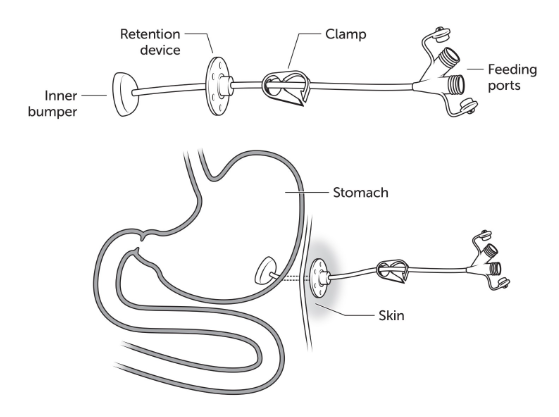
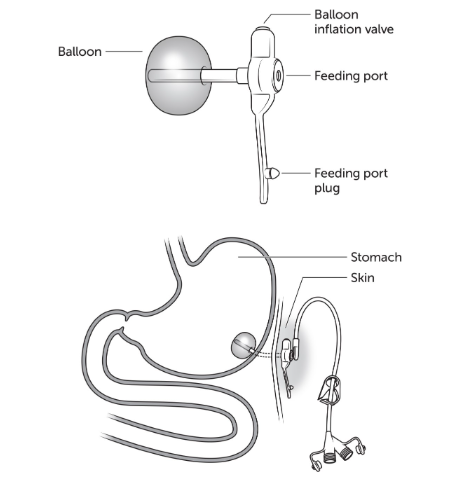
Tube passing through abdominal wall into stomach (figure 1 and 2). Percutaneous endoscopic gastrostomy (PEG) is one type of gastrostomy |
| Gastro-jejunostomy (G-J tube) |
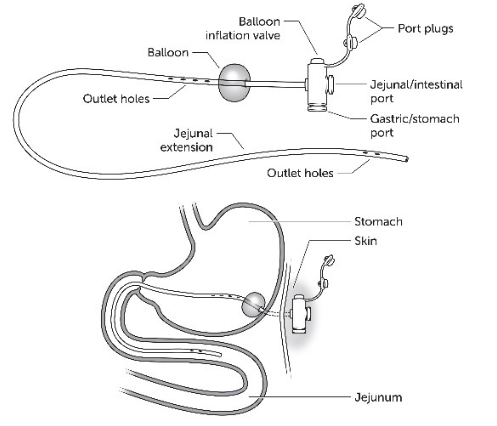
Tube passing through abdominal wall into stomach and past pylorus for jejunal feeding (figure 3). There is often a gastric and jejunal port |
| Jejunostomy |
Tube passing directly through abdominal wall into jejunum for direct jejunal feeding (very rare). Requires surgical replacement |
| Naso-jejunal tube |
Tube from nose passing through stomach, pylorus and into jejunum |
- Gastrostomy and G-J tubes provide nutrition, fluids, medication and venting. They may be required in children with difficulty swallowing or feeding orally, to meet their caloric requirements or for other chronic health needs
- Tubes come in a range of (outer diameter) French (Fr) sizes and lengths (including variable with adjustable external bolsters). Internal balloons or bumpers hold them in place
- Jejunal (post-pyloric) feeding is required for some children. Jejunal tubes are not used for bolus feeding. Jejunal feeds typically run continuously for 16-24 hours per day. A jejunal tube should not be rotated or aspirated as the tube can collapse and recoil. Jejunal tubes can migrate back into the stomach - if feeds are not tolerated, confirm position radiologically
Gastrostomy tube: Initial gastrostomy with internal and external bumper
Low profile button gastrostomy: Established gastrostomy with balloon
G-J tube
Assessment
History
- Date of initial tube placement, including if this is the initial/ primary tube
- Type, diameter (French) and location of tube (See diagrams)
- Time of removal and time since last feed
- Prior history of tube insertion and complications
- Sedation required for prior replacements
- For jejunal tubes - previous or expected tolerance of gastric feeding
Examination
- Assess hydration
- Inspect stoma site
- Irritation, hyper-granulation, constriction
- Inspect tube
- Tube type
- Gastrostomy or G-J tube, tube with inner bumper, low profile balloon tube, long balloon tube, low profile non-balloon tube
- Fr size and length
- Check for tube faults (can be brief and done in more detail after securing stoma appropriately)
- Burst balloon, split tubing, broken button head, slipping outer bumper
Management
Investigations
Investigations are typically not required
A BGL may be required if jejunal tube is removed or there is prolonged duration without feed
Treatment
Replacement of a dislodged gastrostomy tube
First determine if is safe to replace the tube
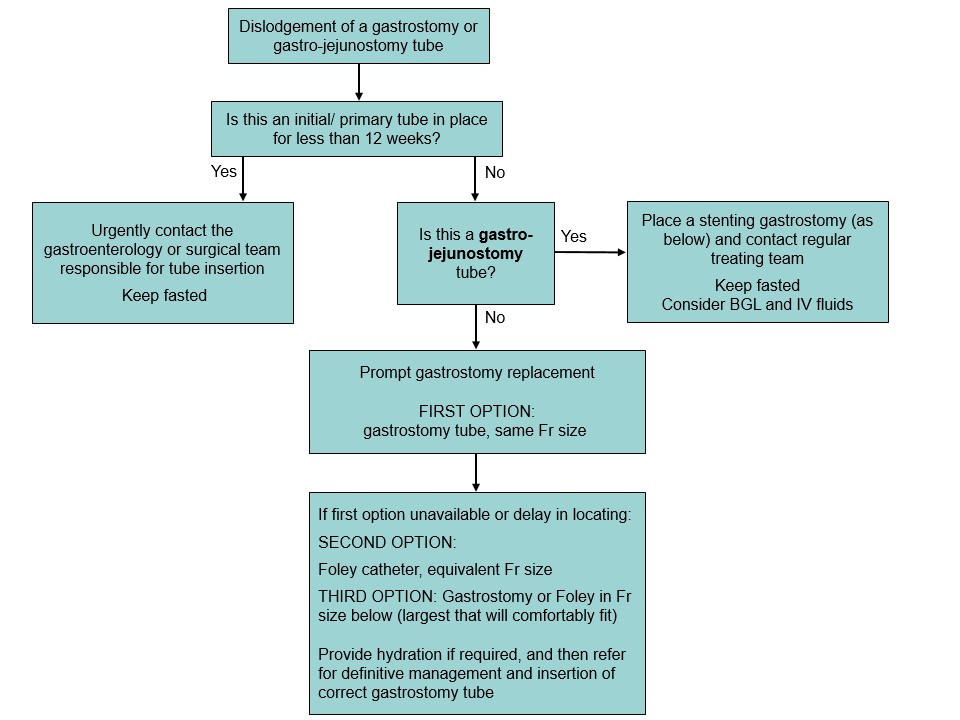
- Initial tubes or those placed for the first time within the last 12 weeks should first be discussed with the inserting team (gastroenterology or surgery) - there is a risk of creating a false tract and insertion into the peritoneum
- Tube reinsertion after 3 months is generally uncomplicated
- Replacement should happen as soon as possible. Aim <4 hours since removal in a local setting due to risk of contraction of the stoma site and potential for decompensation (dehydration, metabolic, missed medications etc). See example insertion video here
Consider if child requires distraction and/or procedural sedation
For a replacement low-profile gastrostomy balloon tube, select the correct-sized Fr size and stoma length (child/family may have)
- If unable to obtain the correct size, consider a long profile balloon gastrostomy, or a catheter (eg Foley, Nelaton) of the correct diameter. Consider additionally preparing a size smaller
- Water-based lubricant, gloves, sterile water and syringes that fit on both the feeding and balloon ports
- Test the balloon by filling and then removing the correct amount of sterile water
- Apply lubricant to the tip of the tube and place it in the stoma. You may need to twist gently to advance or find the direction of the tract. It should advance with only gentle resistance and be a snug fit
- Inflate the balloon with sterile water
- Aspirate from the feeding port with a syringe to confirm placement
- If placement is confirmed, start feeds and check for tolerance
- If unsuccessful, trial the size below until successful. Contact treating team
- If there are any concerns about the location of the tube, or multiple attempts are required, tube position should be checked with a contrast study, and the treating team should be consulted
Replacement of a dislodged G-J tube
- G-J tubes require surgical or fluoroscopic placement
- A gastrostomy tube or foley catheter of similar size should be placed (as above) to preserve the tract, but gastric feed should not be given unless recommended by the treating team
- Consider the need for IV insertion and monitoring BGL if fasting time will be prolonged
Tube leakage
See also skin issues as gastric contents will irritate the skin
Peristomal (around the tube) leakage
- A large amount of leakage eg wetting clothing, soaking through dressing, visible food and milk from the stoma or visibly dripping from the stoma needs review. Smaller volume loss is common and acceptable
- Treat large volume losses as you would a child who is vomiting
| Child is unwell |
Workup as for a child who is vomiting |
| Feed intolerance |
Consider slowing feeds and additional venting. May require treatment for constipation or delayed gastric emptying if contributory |
| Tube too small for opening |
Apply paraffin, regular foam dressings and Stomahesive™ powder if the site remains very wet. Refer to gastrostomy or stoma specialist for review if leaking not manageable |
| Inner bumper/balloon migration/ malfunction |
Check and adjust external retention bolster to ensure internal flange or balloon is snug against the inner stomach wall. Confirm balloon function - aspirate water and refill with appropriate volume for device |
| G-J tube |
Cease feeds and confirm tube tip has not migrated into stomach |
Leakage from tube
- Often requires replacement
- Occasionally caused by delayed gastric emptying, constipation or valve failure. A pulsatile tube flush can be trialled
- Contact the treating team promptly if issues persist
Skin issues
- True stoma site skin infection is rare, and common skin and enteric flora are often recovered if swabbed
| Assessment |
Management |
| Irritation, redness and bleeding |
- Keep skin clean and dry
- Assess for leakage and manage as above
- Apply regular barrier creams
- Apply foam dressings that will wick moisture from the skin. Change regularly if wet, or at least daily
- Hydrocolloid powders can stop bleeding and absorb excess moisture
- If evidence of cellulitis or collection, swab and start antibiotics
- Consider antifungal treatment as candida is common
|
| Granulation tissue |
- Remove and reduce causes of friction
- Absorb exudate and apply pressure (foam dressings)
- Consider use of topical steroid (sparingly), topical antibiotics, antimicrobial dressings and bleach baths in consultation with regular treating team
- Additional treatments may be offered by specialty nursing services
|
Blocked tubes
| Causes |
Treatment |
- Poorly crushed medication
- Inadequate flushes
- Thick feed
- Leaving formula in the tube to curdle
- Poorly blended feeds
- Lumps of powder in feed
|
- Address causes
- Flush with 10-20 mL of warm water using a gentle push-pull motion
- Repeat a few times, and if fails, tube may require replacing
- Do not use excessive force, Coca-Cola™ or other carbonated drinks
|
Consider consultation with local paediatric team when
- Tube placement unsuccessful/not possible, IV fluids may be required
- Feeds not tolerated
Consider consultation with gastroenterology/surgical team or stomal therapy when
- Initial tube placed within the last 12 weeks (urgent review required)
- Unsuccessful tube placement or placement of a smaller-sized tube or Foley catheter
- Dislodgement of G-J tube
Consider transfer when
Child requiring care above the level of comfort of the local hospital
For emergency advice and paediatric or neonatal ICU transfers, see Retrieval Services
Consider discharge when
- Replacement tube is placed and position confirmed
- Feed tolerated without discomfort
Parent information
RCH Kids Info Factsheet: Gastrostomy tube
RCH Kids Video: A child's guide to PEG change
RCH Kids Info Factsheet: Reducing your child's discomfort during procedures
Last updated May 2026