See also
Fever and petechiae
The acutely swollen joint
Hypertension
Haematuria
Intussusception
Key points
- IgA vasculitis (IgAV) is usually mild and self-limiting, with most children requiring supportive care only
- Acute severe abdominal pain requires urgent assessment for complications such as intussusception
- Routine blood pressure and urinalysis monitoring for 12 months is required to detect delayed-onset IgA nephritis (IgAVN)
Background
IgAV, formerly known as Henoch-Schönlein purpura (HSP), is the most common childhood vasculitis
- immune complex-mediated, small vessel leukocytoclastic vasculitis with multi-organ involvement
- most common in primary-school aged children (4-10 years), and rare <2 years of age
- most cases are self-limiting and require supportive care only
- gastrointestinal or renal manifestations require early recognition and escalation - onset of renal manifestations may be delayed and requires monitoring for 12 months
- Recurrence is common (~1/3) within the first 6 months and is usually of milder severity
Assessment
IgAV is a clinical diagnosis
Clinical features include the presence of purpuric/petechial rash with a lower limb predominance AND one or more of the following
- Arthritis/arthralgia (60-80%)
- Abdominal pain (50-75%)
- Renal involvement (20-55%)
History
- Timing and evolution of symptoms: clinical manifestations may evolve over days to weeks and vary in order of appearance
- Rash occurs in almost all cases, but up to 1/3 have other manifestations that can precede it by several days
- A preceding infection is common, particularly upper respiratory tract infections
- Colicky abdominal pain, vomiting, or gastrointestinal bleeding may indicate a significant gastrointestinal manifestation such as intussusception
- Arthralgia/ arthritis most commonly affects large lower-limb joints causing pain, limp or refusal to weight bear
- Haematuria, reduced urine output, or oedema
- Scrotal swelling or testicular pain (requires assessment to exclude testicular torsion)
Examination
|
Assess for |
Features |
Vital signs |
Hypertension
Fever |
Elevated blood pressure (≥Stage 2 hypertension)
Low-grade fever +/- malaise can occur |
Skin (almost all children) |
Purpura/ petechiae
Subcutaneous oedema |
Usually symmetric lesions, may be palpable
Over extensor surfaces and dependent areas of lower limbs and buttocks, sometimes extending to trunk and forearms
Rare on face, palms or soles
Urticarial or maculopapular rash may precede classic rash
Lesions may range from petechiae to ecchymoses to haemorrhagic bullae, ulceration or necrosis (rare)
Usually gravity dependent areas |
Joint (common) |
Arthralgia +/- arthritis
Mobility |
Usually non-migratory oligoarticular (<5 joints) affecting large (hip, knee, ankle) joints in the lower limbs co-locating with rash
Mild-severe joint pain, tenderness and swelling without warmth or effusion
Difficulty and/or refusal to weight bear |
Abdominal (common) |
Gastrointestinal vasculitis (ileus, bowel ischaemia, necrosis, perforation) or intussusception
Rare: Protein-losing enteropathy, appendicitis, cholecystitis, pancreatitis |
Mild-severe abdominal pain, GI bleeding, bowel obstruction, peritonism
Peripheral oedema, ascites, pleural/ pericardial effusion |
Renal (common) |
Nephritis (IgAVN) |
Most commonly isolated microscopic haematuria - may be macroscopic
Proteinuria
Nephritic and/or nephrotic syndrome
Hypertension
Renal impairment/ failure (reduced eGFR) |
Genito-urinary (less common) |
Orchitis +/- testicular/ scrotal haemorrhage or haematoma
Ureteric stenosis (rare) |
Testicular or scrotal pain, swelling, bruising (requires exclusion of testicular torsion)
Renal colic (unilateral or bilateral) |
Neurological (rare) |
Cerebral vasculitis +/- intracerebral haemorrhage +/- raised intracranial pressure
Peripheral neuropathy |
Isolated headache is common
Altered conscious state, seizures, focal neurological signs
Altered sensorium or motor function |
Respiratory (rare) |
Interstitial pneumonia usually diffuse alveolar haemorrhage (DAH) |
Respiratory distress +/- signs of anaemia or cardiovascular instability |
Other (rare) |
Ocular
Cardiac
Muscular |
Subconjunctival haemorrhage
Carditis
Intramuscular haemorrhage |
Typical rash and distribution
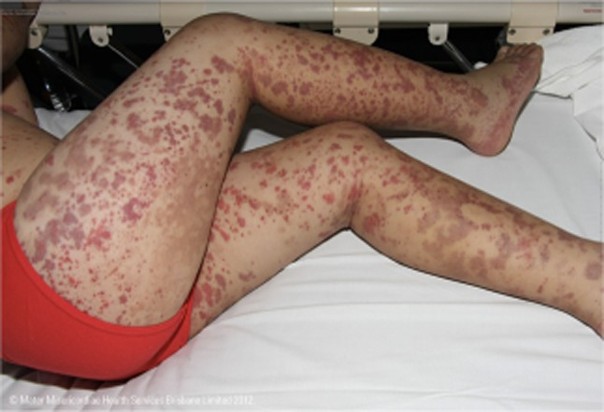
This image has been reproduced with permission from Trnka P. Henoch-Schönlein purpura in children. J Paediatr Child Health. 2013;49(12):995-1003
Management
Investigations
There is no single diagnostic test for IgAV; diagnosis relies on clinical manifestations (and rarely histopathological findings)
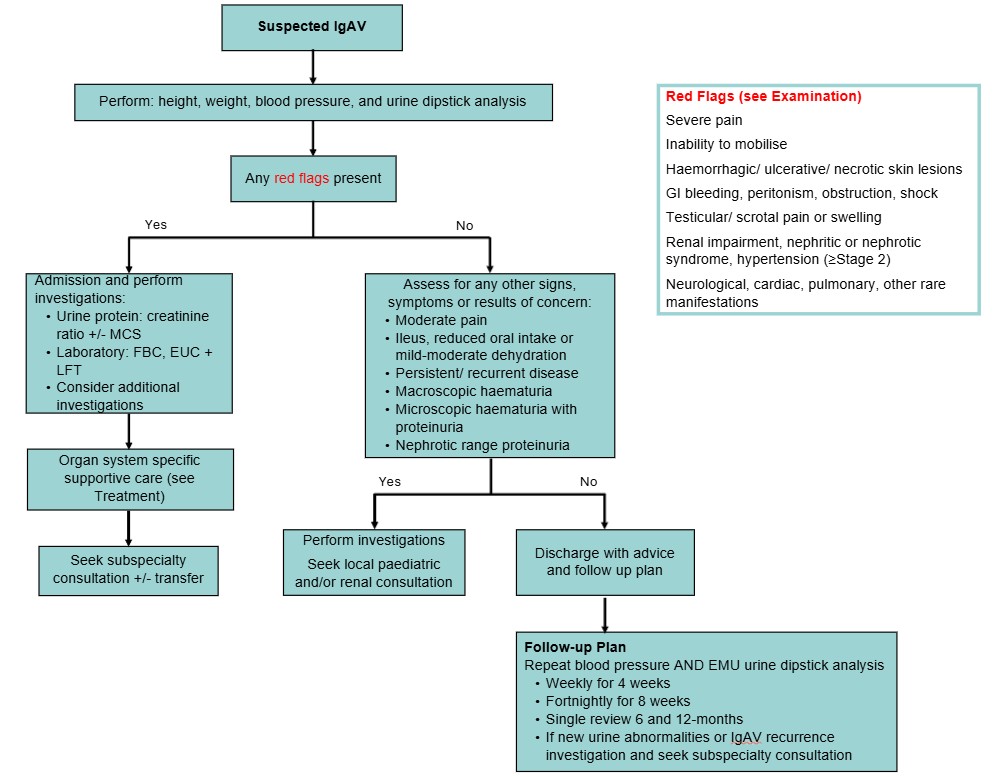
All children with suspected IgAV should have:
- Height
- Weight
- Blood pressure
- Urinalysis (and if abnormalities include urine protein: creatinine ratio (UPCR) - ideally early morning urinalysis (EMU) should be performed
Children with moderate to severe IgAV (red flags and/or warranting admission and/or subspecialty consultation) should also have
Additional investigations are performed to assess for IgAV manifestations or differentials
- Blood film
- Coagulation profile
- Bacterial and/or viral cultures/PCRs (See Petechiae and purpura)
- ASOT and Anti-DNaseB
- CRP and ESR
- ANA, ENA, dsDNA, C3 and C4 and ANCA (including MPO and PR3 antibodies), in consultation with rheumatology
Treatment
Musculoskeletal manifestations
- Bed rest and/or reduced physical activity
- Elevation if oedema present
- Simple analgesia (if no contraindications)
- Paracetamol
- Ibuprofen, or Naproxen 7.5 mg/kg/dose (max 500 mg) oral bd
- Corticosteroids: consider in cases of severe or persistent pain
Gastrointestinal manifestations
Mild gastrointestinal pain or symptoms
- Support hydration and nutrition
- Simple analgesia (if no contraindications) and/or anti-emetics
Moderate to severe abdominal pain or gastrointestinal bleeding
- Admit for supportive measures and ongoing reassessment for evolving manifestations
eg intussusception, bowel ischaemia or perforation, protein-losing enteropathy, pancreatitis, appendicitis or cholecystiti
- Surgical, radiology and/or gastroenterology consultations where appropriate
- Conisder corticosteroids: of most benefit if initiated within 3 days of onset of symptoms
- Prednisolone: 1-2 mg/kg/day (max 60 mg) oral daily for 1-2 weeks OR
- Methylprednisolone: 1-2 mg/kg/day (max 60 mg) intravenous until able to tolerate and/or absorb via oral administration route
Urogenital manifestations
Orchitis
- Surgical consultation and exclusion of testicular torsion
- Simple analgesia
- Corticosteroids: consider prednisolone 1-2 mg/kg/day (max 60mg) oral daily for 1-2 weeks
Renal manifestations
- If there are concerns of nephritis consult nephrology
- Corticosteroids: not used for prophylaxis. No evidence prophylactic treatment prevents the development on IgAVN
Follow up
Review for new or ongoing renal manifestations
- Renal manifestations: ~90% of those who will develop renal disease present within 2 months, and ~97% within 6 months, so ongoing monitoring is essential
- Long-term kidney impairment is rare (<1–2%)
- Follow up can be with the child’s GP or paediatrician unless follow up with a subspecialty team (for IgAV or IgAVN) is required
Mild IgAV disease
- Mild symptoms and normal urinalysis or isolated microscopic haematuria or transient mild proteinuria
- Requires follow up with blood pressure and ideally EMU
| Frequency | Review |
Weekly for 4 weeks (Month 1) |
BP + EMU |
Fortnightly for 8 weeks (Months 2-3) |
BP + EMU |
Single review at 6 and 12 months (Months 6-12) |
BP + EMU |
[Optional] Single review at 9 months |
BP + EMU |
If there is no IgAV recurrence and urinalysis is normal at 12 months, no further routine follow up is recommended
If there are new urine abnormalities and/or symptoms of IgAV recurrence
- repeat investigations
- subspecialty consultation recommended
Consider consultation with local paediatric team when
- Any red flag features
- Severe pain
- Inability to mobilise
- Severe skin disease (haemorrhagic/ ulcerative/ necrotic skin lesions)
- Gastrointestinal bleeding, peritonism, obstruction, severe dehydration/shock
- Testicular scrotal pain/ swelling
- Renal impairment, nephritic syndrome, nephrotic syndrome, Hypertension (≥Stage 2)
- Neurological, cardiac, pulmonary, other rare manifestations
- Moderate pain
- Gastrointestinal dysfunction (eg ileus) or dehydration
- Persisting or recurrent IgAV disease
Consider consultation with a renal specialist
- Renal impairment: reduced eGFR <90 mL/min/1.73m2 (calculated using CKiD U25 eGFR calculator)
- Nephritic syndrome
- Hypertension (≥Stage 2)
- Macroscopic haematuria
- Microscopic haematuria with proteinuria
- Nephrotic syndrome
- Nephrotic-range proteinuria: spot UPCR ≥200 mg/mmol; ≥2 mg/mg; ≥3+ or 4+ on urinalysis
- Proteinuria, using UPCR
- Moderate: UPCR 100-200 mg/mmol or 1-2 mg/mg or 2+ on urine dipstick analysis for ≥2 weeks
- Mild: UPCR 20-50 mg/mmol or 0.2-0.5 mg/mg or 1+ on urine dipstick analysis ≥4 weeks
Consider transfer when
care required for child is beyond the comfort level of the health care service
For emergency advice and paediatric or neonatal ICU transfers, see Retrieval services
Consider discharge when
Discharge advice
- Most symptoms resolve within 4 weeks, and almost all children recover fully
- Rash (petechiae/purpura) usually settles over about 10 days and is often the last feature to resolve
- Joint symptoms are nondamaging and improve over days to a few weeks
- Uncomplicated abdominal pain usually improves within a few days but may recur intermittently for several weeks
- Renal involvement occurs in a minority of children and most children who develop kidney involvement do so by 6 months, so follow up urine testing is important
- Long-term kidney impairment is rare (<1-2%) and overall prognosis is excellent in most children
- Recurrence occurs in up to one third of children, usually within 6 months
- Parents should seek urgent medical review if their child develops severe abdominal, joint or skin pain, any scrotal pain, blood in urine or stool, reduced urine output, or any sudden deterioration
IgAV discharge follow up template
Victoria (Kids Health Info): Henoch-Schonlein purpura
Western Australia (PCH): Henoch-Schonlein purpura
Additional notes
Definitions
- Atypical IgAV rash: extensive +/- diffusely distributed lesions
- Persisting IgAV: the typical purpuric/ petechial rash persisting for >1 month
- Recurrent IgAV: reappearance of the typical purpuric/ petechial rash or other systemic manifestations of vasculitis following a symptom-free period of at least >1 month
Last updated August 2026
- The UK Kidney Association: The initial management of IgA Vasculitis (Henoch Schönlein purpura) in children and young people. 2022. Available: https://ukkidney.org/sites/renal.org/files/R2vFINAL_IgA%20vasculitis%20-%20initial%20management220523.pdf
- The UK Kidney Association: The management of complications associated with IgA Vasculitis (Henoch Schönlein purpura) in children and young people. 2022.Available: https://ukkidney.org/sites/renal.org/files/R1vFINAL_IgA%20vasculitis%20-%20complications220523.pdf
- Vivarelli M, Samuel S, Coppo R, Barratt J, Bonilla-Felix M, Haffner D et al. International Pediatric Nephrology Association. IPNA clinical practice recommendations for the diagnosis and management of children with IgA nephropathy and IgA vasculitis nephritis. Pediatr Nephrol. 2025;40(2):533-569
- Weiss P F, Feinstein J A, Luan X, Burnham J M, Feudtner C. Effects of corticosteroid on Henoch-Schönlein purpura: a systematic review. Pediatrics. 2007;120(5):1079-1087
- Zhao Q, Yang Y, He S W, Wang X T, Liu C. Risk factors for intussusception in children with Henoch-Schönlein purpura: A case-control study. World J Clin Cases. 2021;9(22):6244-6253