Key points
- Urine (pee) tests are a very common type of health test.
- Health professionals can test pee for a range of conditions, including urinary tract infections (UTIs) and kidney function.
- A urine test is the only way to confirm a UTI diagnosis.
- There are three main ways to get a urine sample from babies and young children: clean-catch, catheter, or suprapubic aspirate (SPA).
- Clean-catch samples are the least upsetting for children, but they are more likely to be contaminated.
- For older children who can pee on request, midstream samples are best for testing.
- Your child’s doctor will tell you which type of urine sample to collect and tell you where you get any equipment you need.
What are urine tests?
Urine (pee) tests are a very common type of health test.
In children, the main reason for a urine test is to check for infection. A urine test is the only way to confirm a UTI diagnosis.
Less often, health professionals use urine tests to check a child’s:
- Kidney function
- Salt, hormone, or protein levels.
Collecting a urine sample from younger children
Babies and young children usually do not yet have enough control over their bladder to pee ‘on request.’ This makes it hard to get a sample when you need it.
There are three main ways to get a urine sample from babies and young children: clean-catch, catheter, and suprapubic aspirate (SPA). Your child’s doctor will tell you if they need a specific type of sample.
Clean-catch
A clean-catch urine sample is when you catch pee in a container for testing. It is best to catch pee from the middle of the stream, not the start, as it is less likely to be contaminated by bugs naturally found on the skin.
Most children in nappies pee around every hour or two, so you will need to be patient.
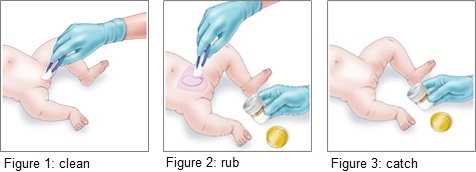
How to collect a clean-catch urine sample
- Get the sample container ready.
- Make sure the lid is off.
- Do not touch the inside of the container.
- Offer your child a drink – it is fine to breastfeed, or to use a bottle or cup.
- Remove your child’s nappy.
- Clean the skin around your child’s genitals using toilet paper or a clean, wet face washer.
- Watch your child closely so you notice if they start peeing. You will need to move quickly to get the sample.
- To encourage your child to pee, you can gently rub their lower abdomen (tummy) for a few minutes using a clean piece of gauze soaked in cold water.
- Try to catch the middle part of the pee stream, rather than the first part. The pee from later in the stream is cleaner and better for testing.
- Make sure to hold the container away from your child’s skin when catching the sample. This will stop bacteria on your child’s skin (or your own skin) from contaminating it.
- Put the lid on the sample container and label it, if required.
Catheter
A catheter is a soft plastic tube that a doctor or nurse threads into the bladder through the urethra (hole where pee comes out). Using a catheter is a quick and effective way to get a urine sample. However, it can be uncomfortable, and your child will
need to be held still while a health professional inserts it, which may upset them.
Pain medicine and distraction can help to keep your child calm if they need a catheter.
Suprapubic aspiration (SPA)
Suprapubic aspirate (SPA) is when a doctor inserts a needle through the skin of the lower abdomen (tummy) into the bladder to take out a urine sample. They may do an ultrasound first to check that the bladder has enough pee in it.
An SPA is a very quick and safe way to get a urine sample, but it can be uncomfortable as it involves a needle. Your child will need to lie on their back and be held still.
Which type of urine sample collection is best?
The best type of urine sample collection depends on the reason for the test.
A clean-catch sample will not cause your child any pain or discomfort, but it takes time and a bit of luck to collect. It is also more likely to get contaminated, so it may not be able to confirm a UTI diagnosis.
Catheter and SPA samples tend to be quicker to collect and less likely to get contaminated, but they can be uncomfortable and upsetting for your child. Doctors usually suggest a catheter or SPA sample if the test is urgent – such as for a very young baby
– or if it is not possible to get a clean-catch sample.
Collecting a urine sample from older children
It is much easier to collect a urine sample from older children who can control their bladder and pee when asked.
How to collect a urine sample from older children
- Get the sample container ready. Do not touch the inside.
- Clean the skin around your child’s genitals using toilet paper or a clean, wet face washer.
- If they are old enough to follow instructions, you can explain what they need to do and let them do it themself.
- Let your child start to pee into the toilet.
- When they are about halfway through peeing, move the container into the stream to collect the sample. This is called a midstream sample. Do not let their skin touch the container.
How are urine samples tested?
There are three main ways of testing urine samples.
- Dipstick test: A quick test where a doctor or nurse dips a special stick into the urine sample. Parts of the stick will change colour depending on what is in the pee. For example, infection-fighting cells or chemicals made by bacteria.
- Reliability: Fairly reliable, but not 100% – especially in babies.
- Speed: Results are instant.
- Initial lab test: When scientists look at a urine sample under a microscope for signs of infection.
- Reliability: More reliable than a dipstick, but still not 100%.
- Speed: Often only takes an hour or two in hospital; longer in other health settings.
- Lab culture test: When scientists try to grow bacteria in the urine sample.
- Reliability: Most reliable form of testing. It will confirm (or rule out) a diagnosis, and test any bacteria against commonly prescribed antibiotics, to see which will work best.
- Speed: Several days to complete.
Your child’s doctor will usually decide to treat based on the first two methods. However, they may ask for a follow-up lab culture test to confirm the diagnosis and see whether certain antibiotics will work. The results of the test may lead the doctor
to change your child’s antibiotics.
Common questions about urine tests and samples
What happens if I get a urine sample from the end of my child’s pee stream?
It is okay if the urine sample is from the end of your child’s pee stream. The important thing is not to catch the start of the pee stream, as it is more likely to be contaminated.
Can I collect pee from my child’s nappy for testing?
Pee from a child's nappy cannot be used for testing, as the bacteria on their skin will contaminate the sample.
How much pee do I need to collect for testing?
Try to collect at least 30ml of pee for testing; this is about two tablespoons. Most sample containers are around 60 to 70ml, so aim to fill them over halfway. A doctor or nurse will be able to tell you whether the sample is enough if you are
not sure. Tests can be done on even a very small amount of urine.
How long will a urine sample last before it is too old to test?
A urine sample at room temperature should be tested within an hour. If there is a delay between getting the sample and having it tested, you can store the sample in a fridge at 4°C for up to 24 hours.
How painful is a suprapubic aspirate (SPA)?
An SPA hurts about as much as a vaccination needle or a blood test. Occasionally, a doctor or nurse may use numbing cream on the skin before the SPA to reduce your child's discomfort, but this takes 45 minutes to work. In small babies, oral sucrose
can give them extra pain relief.
What is a urine collection bag?
A urine collection bag is a bag to collect pee in. It is sometimes used to catch pee from babies instead of a container. Urine collection bags can be used to collect urine for testing things such as salt, hormone, or protein levels. However, they
cannot usually be used when testing for UTIs, as bacteria from the skin often contaminate the sample.
For more information
Developed by The Royal Children’s Hospital Emergency department. We acknowledge the input of RCH consumers and carers.
Reviewed June 2026
Please always seek the most recent advice from a registered and practising clinician.