See also
Febrile child
Sepsis
Local antimicrobial guidelines
Key points
- Orbital (postseptal) cellulitis is an emergency with serious complications, including intracranial infection, cavernous sinus thrombosis and vision loss
- Urgent imaging and surgical consultation (ENT and ophthalmology) should be considered for any child with suspected orbital cellulitis
- Periorbital (preseptal) cellulitis in a well child can often be treated with oral antibiotics if follow-up is assured
Background
- Periorbital and orbital cellulitis are distinct clinical diseases, though have overlapping clinical features and therefore can be difficult to differentiate
- Orbital cellulitis
- infection within the orbit (ie postseptal, the structures posterior to the orbital septum)
- surgical emergency with major complications including loss of vision, abscess formation, venous sinus thrombosis and extension to intracranial infection with subdural empyema, and meningitis
- >80% of cases are a complication of local sinus disease
- Periorbital cellulitis
- infection of the eye lids and surrounding skin not involving the orbit (ie preseptal, the structures anterior to the orbital septum)
- often arises from local infection of the eyelids or surrounding skin
- The globe is not involved in either infection
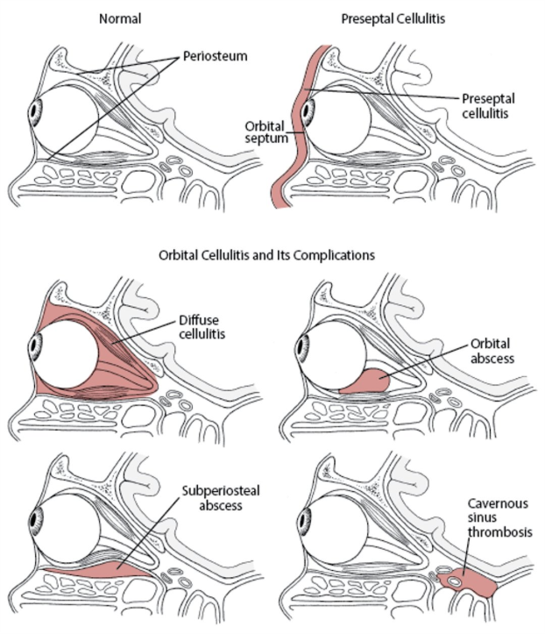
From the MSD Manual Professional Version, edited by Sandy Falk.
Copyright © 2026 Merck & Co., Inc., Rahway, NJ, USA and its affiliates.
All rights reserved. Available at https://www.msdmanuals.com/consumer.
Accessed 19 June 2026
Assessment
History
- Unilateral eye pain/tenderness
- Vision change
- Fevers
- Recent sinus or upper respiratory tract infections
- Recent injuries or surgeries around eye area
- Immunisation history, particularly Haemophilus influenzae type b (Hib)
Examination
- Unilateral eyelid swelling and erythema
- Unilateral eye pain or tenderness
Features particularly concerning for orbital cellulitis
- Painful or restricted eye movements
- Visual impairment
- reduced acuity
- relative afferent pupil defect
- diplopia
- Proptosis
- Severe headache, vomiting or other features of intracranial involvement
Differential diagnosis
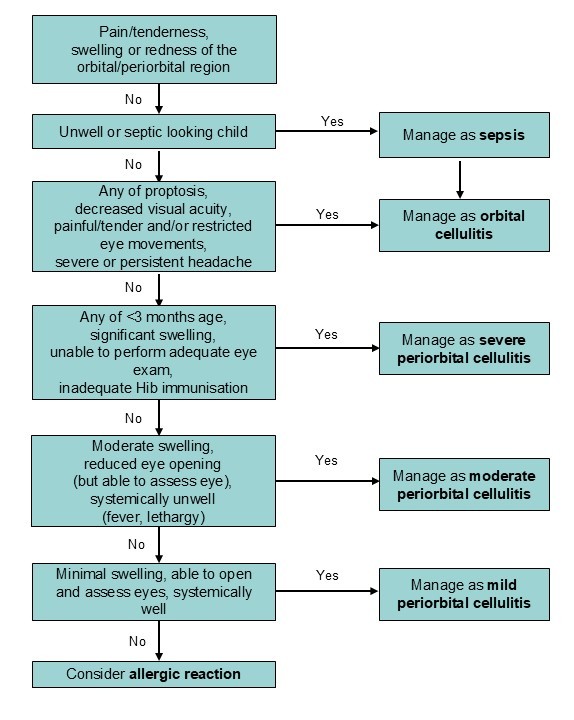
Bilateral findings and/or painless (or non-tender) swelling in a well-looking child is more likely to be an allergic reaction. Nephrotic syndrome can also present similarly
Consider gonorrhoea and Chlamydia infections in neonatal presentation (send PCR swabs). See Acute red eye
Periorbital and orbital cellulitis differential diagnosis flowchart
Management
If inadequate Hib vaccination, treat as severe periorbital cellulitis
Orbital cellulitis
- Admit
- Keep fasted until need for surgery clarified
- Seek ENT and ophthalmology advice urgently
- Urgent contrast enhanced CT scan of orbits, sinuses +/- brain
- If child is clinically septic, see Sepsis
- Investigations
- Antibiotics (see below) START IMMEDIATELY
- Treat underlying sinus disease eg nasal decongestants, steroids (often guided by ENT)
Periorbital cellulitis
Severe
Inpatient investigations and management as per orbital cellulitis
Moderate
Inpatient management or consider Hospital-In-The-Home (HITH) admission if available locally
- Consider blood culture if febrile and unwell
- Antibiotics (see below)
- Once improving, change to oral antibiotics
- If not improving or deteriorating within 24–48 hours, consider managing as severe periorbital cellulitis
Mild
Summary of antibiotic treatment
Antimicrobial recommendations may vary according to local antimicrobial susceptibility patterns. Please refer to local guidelines. These may include advice regarding community acquired MRSA
|
Intravenous therapy |
Oral therapy |
Total duration |
| Orbital cellulitis |
3rd generation cephalosporin (high dose)
- Cefotaxime 50 mg/kg (max 2 g) IV 6H OR
- Ceftriaxone 100 mg/kg (max 4 g) IV daily
If suspected MRSA, add vancomycin (see link for dosing) Consider adding metronidazole if not responding
|
When de-escalating, switch to Amoxicillin with clavulanic acid (doses based on amoxicillin component) 22.5 mg/kg (max 875 mg) oral bd |
10 days minimum IV duration based on clinical severity and improvement Usually at least 3-4 days of IV therapy
|
Severe periorbital cellulitis or not responding, or <5 years of age and non-Hib immunised |
3rd generation cephalosporin (high dose as above) |
When de-escalating, switch to amoxicillin with clavulanic acid (as above) |
10 days minimum IV duration based on clinical severity and improvement Usually at least 3-4 days
|
| Moderate periorbital cellulitis |
Cefazolin 50 mg/kg (max 2 g) IV 8H OR Ceftriaxone 50 mg/kg (max 2 g) IV daily (HITH) |
When improving, switch to oral antibiotics as per mild periorbital cellulitis |
7-10 days IV therapy duration based on clinical severity and improvement Usually 1-2 days of IV therapy
|
| If suspected MRSA |
Clindamycin IM/IV 5-15 mg/kg (maximum 600 mg) 8H Usual dose 10 mg/kg (maximum 450 mg) 8H |
5-10 mg/kg (maximum 450 mg) 8 hourly |
As per severity duration |
| Mild periorbital cellulitis |
Not applicable |
Cefalexin 20 mg/kg (max 750 mg) oral tds |
7-10 days |
Consider consultation with local paediatric team when
- orbital cellulitis suspected
- moderate-severe periorbital cellulitis
- no improvement or deterioration after 24-48 hours of therapy
Consider transfer when
- severe periorbital cellulitis or orbital cellulitis
- suspecting intracranial involvement with altered conscious state, seizures or focal neurological signs
- child requires care above the level of comfort of local hospital
For emergency advice and paediatric or neonatal ICU transfers, see Retrieval Services
Consider discharge when
Mild periorbital cellulitis
- oral antibiotic course prescribed
- follow-up assured
Moderate periorbital cellulitis
- after 24–48 hours of IV antibiotics and with improvement
- able to tolerate oral antibiotics
- follow-up assured
Last updated July 2026